Workspace & billing
Webmarketer workspace
A Webmarketer workspace groups a set of projects.
Except on the Free billing plan, you can create as many projects as you like within a workspace.
A workspace generally matches one organization or company. The payment method is attached to that workspace. It is generally best to create one workspace per organization.
Your workspace name is never present in the scripts you place on your website. It is therefore impossible for a visitor to tell that two Webmarketer projects are managed by the same company.
Interaction usage
Each billing plan includes an interaction allowance, usable every month across all the projects of your workspace.
If the number of interactions available in your billing plan is lower than your actual traffic, you have two options:
- Move to a higher plan
- Enable the overage allowance
The overage allowance feature tells Webmarketer to keep processing interactions, even once the interaction allowance of your billing plan is exhausted.
Every batch of 1,000 interactions is billed individually at the beginning of the next billing period, at the price stated in your billing plan, and is due from the first excess interaction onwards.
To stay in control of your costs, you can set a maximum number of extra interactions to ingest each month.
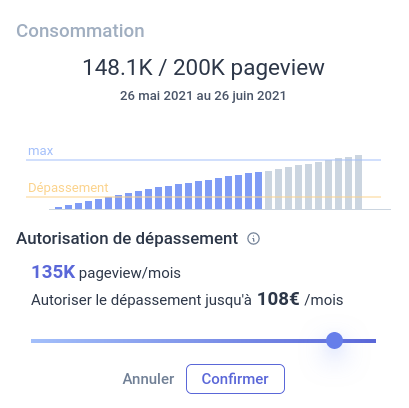
If you enable the overage allowance but the interactions totalled over the month end up not exceeding the number included in your plan, nothing extra is billed.
Your data in case of overage
If the interaction limit is exceeded (with or without overage allowed), your project's interactions are no longer processed until the next billing period.
This can lead to inconsistencies in your data:
- An artificial increase of the conversion rate: no interaction can be attributed to the events Webmarketer still counts.
- An increase of the actual cost per session, since ad spend keeps being imported while interactions are no longer processed by Webmarketer.
So that you can always trust the data Webmarketer displays, we provide a mechanism to recover the excess interactions (in case of an overage beyond the limit) during the 12 months following the overage.
So in case of an overage, contact Webmarketer support so we can look into re-ingesting the missing data.
Billing
Billing plan
Webmarketer offers 3 billing plans:
- Free
- Standard
- Premium
Each of those plans unlocks features or lifts usage limits.
To compare our billing plans visually, see the feature list on our pricing page. To learn more about the limits and how they apply, see the Limits section.
Billing period
The billing period is one month of Webmarketer usage. During that period you have the interaction allowance included in your plan. The interactions included in your allowance are valid for the billing period (1 month) and do not carry over to the next one.
Lifecycle of a billing plan:
- Payment of the first billing period
- For one month, you have the interaction allowance provided by your plan
- At the end of the month of usage, an automatic payment is taken, a new billing period starts and your interaction allowance is reset
Changing billing plan
You can change your workspace's billing plan at any time:
- upgrade to a higher plan.
- downgrade to a lower plan.
When downgrading, the unused part of the billing period is credited pro rata of the remaining days as Webmarketer credits. Those credits are used on your next automatic payments or on future billing plan changes.
When upgrading, the unused part of the billing period is deducted from your new monthly payment, pro rata of the remaining days.
Any plan change redefines your billing period. So if your billing period runs from January 1 to February 1 and you decide to change your billing plan on January 15, your new billing period runs from January 15 to February 15.
Limits
Feature limits
Some features may not be available to users on the Free plan.
Examples of Free plan limits:
- Creating custom integrations To analyze traffic sources that do not benefit from Webmarketer's simplified integration yet.
- Using advanced attribution rules To weight how your events are attributed to your traffic sources.
Volume limits attached to the workspace
Volume limits are applied at the workspace level (totalled across all the projects of the workspace):
- Number of projects per workspace (Free only)
- Number of integrations (Free only)
- Number of interactions
Volume limits attached to the project
Volume limits are applied to each project of a workspace:
- Number of attribution models (2 on the Free plan, 5 on the paid plans)
Retention period
How long your data is retained depends on your billing plan.
It defines how long Webmarketer keeps your data, and affects every data report available in Webmarketer (dashboard, performance explorer, and so on).
Maximum attribution window
The attribution window lets you define the time frame used to attribute an event to one or more traffic sources.
For example, for an "online order" event on an e-commerce website:
- A 90-day attribution window analyzes the interactions a visitor had within the 90 days preceding an online order.
- A 365-day attribution window takes into account every interaction made in the year preceding the order.
To learn more about attribution, see the Models and attribution page.