Traffic sources
Traffic sources are the entry points through which your visitors reach your website.
To attribute your events to campaigns, Webmarketer has to identify the origin of every interaction that happened on your websites. That identification works natively thanks to the referrer sent by the browser when a website is visited, but also thanks to URL parameters you can configure in your ad campaigns.
Two types of traffic sources are available in Webmarketer:
- Standard traffic sources: referring sites, organic, social, LLM, direct.
- Advertising traffic sources: ad platforms and custom connectors.
You can add traffic sources directly from your Webmarketer project.
Node
In Webmarketer, every traffic source can be modeled as a tree. That representation lets you analyze performance at a coarser or finer granularity, depending on your needs.
For example, Meta Ads traffic sources are modeled as follows:
- Child node: ad
- 1st parent node: ad group
- 2nd parent node: campaign
- 3rd parent node: ad account xxx-xxx-xxxx
This model lets you track the performance of your ad campaigns, your ad groups and your ads, but also the performance of your ad accounts.
How granular the tree is depends on the traffic source. Organic and social traffic sources, for instance, are modeled with a single parent node (the search engine or the social network), whereas advertising traffic sources are all modeled with several parent nodes (ad account, campaign, ad group, and so on).
Standard sources
Standard sources are tracked automatically by Webmarketer, with no configuration needed. They are available in every Webmarketer project.
Referring sites
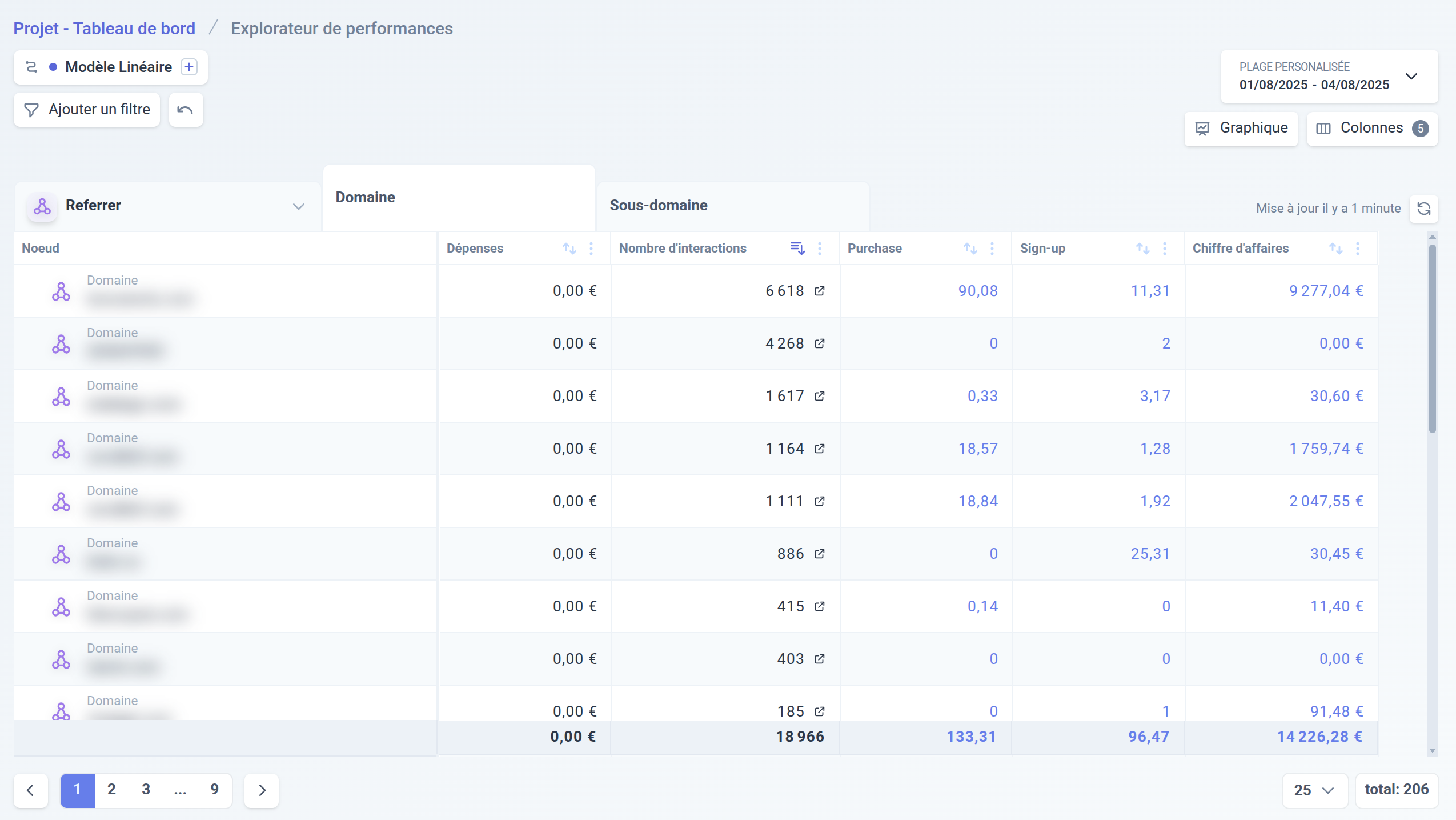
This traffic source lets you analyze the performance of your referring sites (referral), by tracking what visitors do on your website after clicking a link on a referring site.
The node structure offered for this traffic source is:
- Child node: subdomain of the referring site (e.g.
fr.journal.com) - 1st parent node: main domain (e.g.
journal.com)
If you work with partner websites, you can refine the level of analysis by adding URL parameters to your redirect links; see the section on custom connectors.
Organic
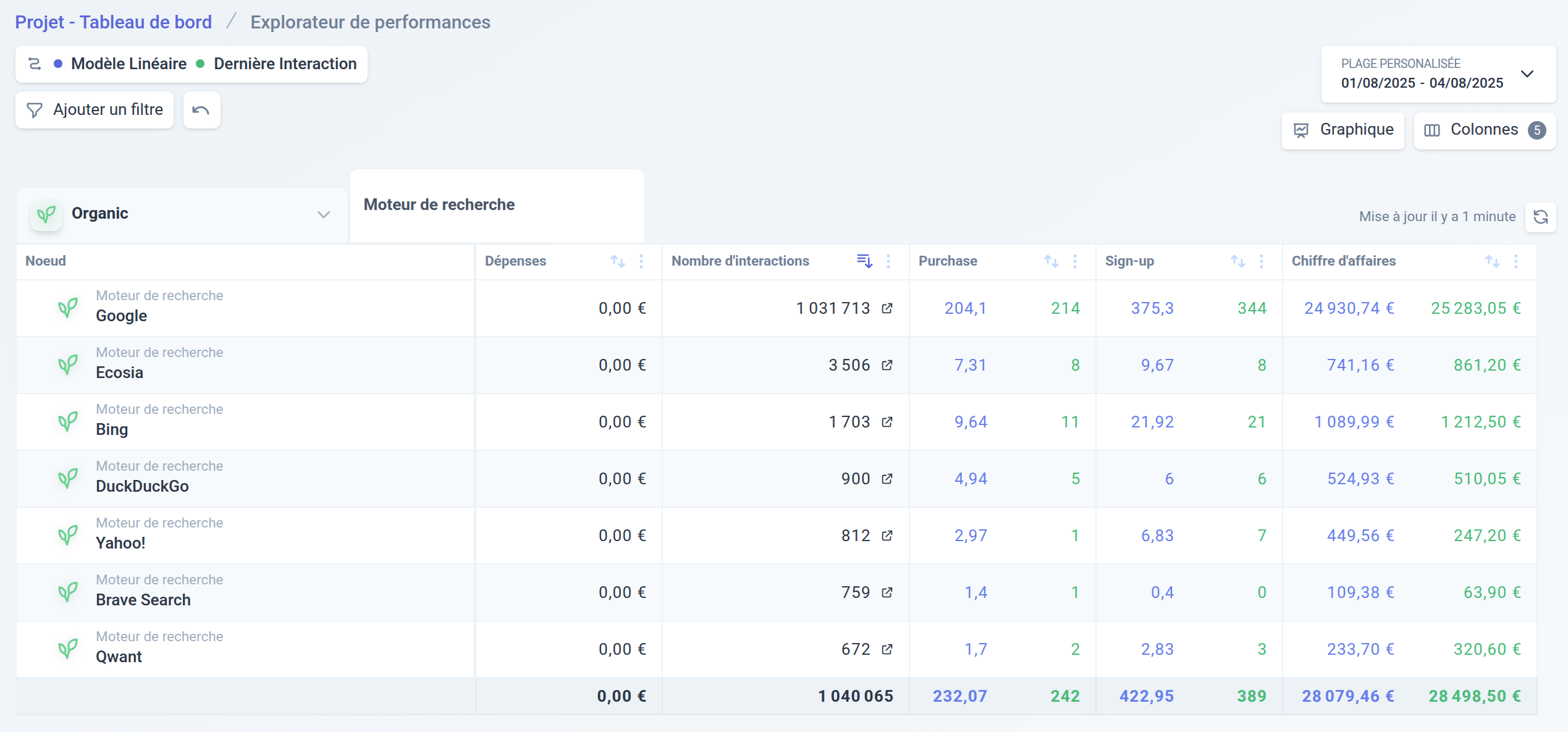
Organic traffic covers all the traffic brought in by search engines. Webmarketer can refine organic traffic analysis by offering a per-search-engine view of that traffic.
Popular search engines are broken down into separate nodes, so you can attribute all or part of your sales and leads to a search engine, and thereby assess how SEO contributes to your goals.
Social
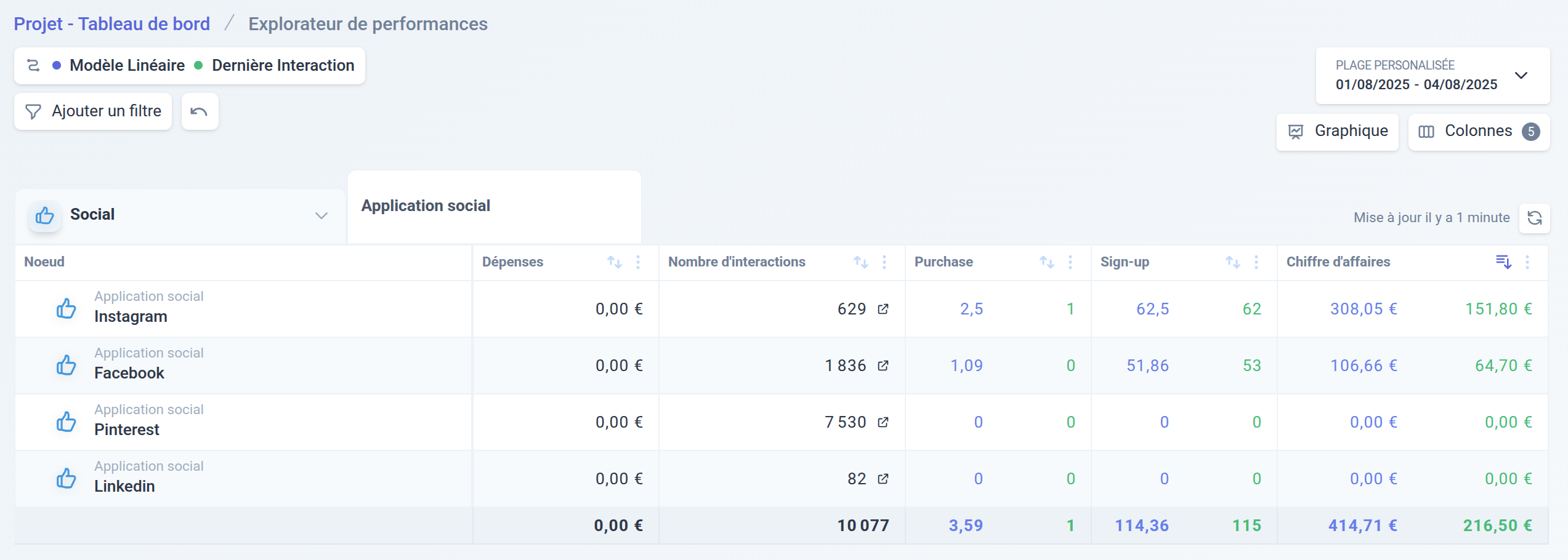
Social traffic is the traffic coming from social networks. As with organic traffic, Webmarketer is able to determine which social networks the traffic comes from.
Advertising sources
Ad platforms
Every interaction tracked by Webmarketer is linked to a traffic source.
When Webmarketer works out where an interaction came from, it starts by looking for a wmktid URL parameter.
That parameter is a unique identifier pointing to both the ad account and the Webmarketer project.
As introduced in the Node section, traffic sources are modeled as a tree. Just like in the ad platforms, that structure lets you analyze performance at a coarser or finer granularity, depending on your needs.
For Meta Ads, for example:
- Child node: ad
- 1st parent: ad group
- 2nd parent: campaign
- 3rd parent: ad account
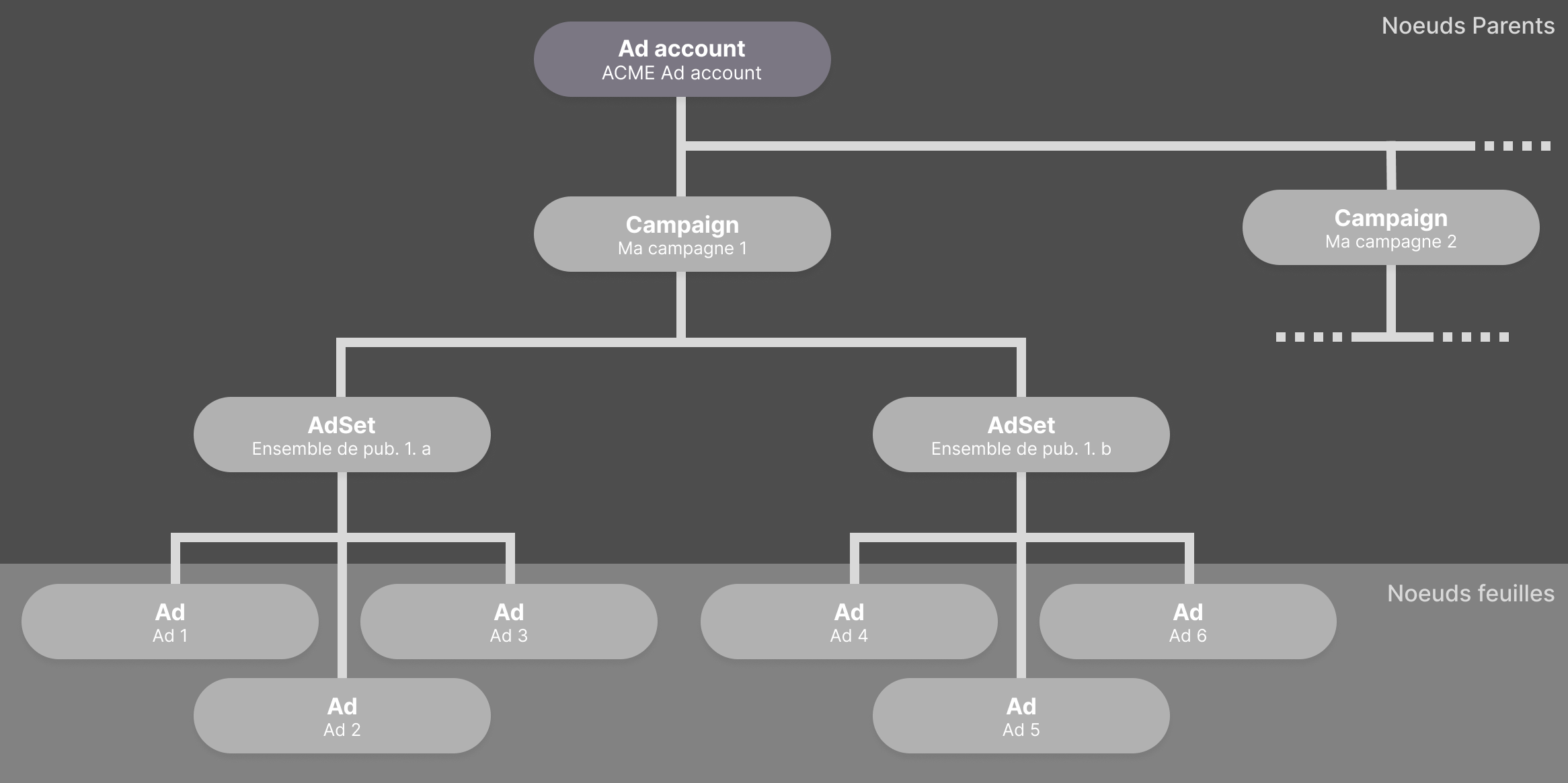
Once the ad account is identified, Webmarketer then looks for the leaf node (the lowest one in the tree) the interaction originated from. As with identifying the ad account, identifying the leaf node relies on the URL parameters.
The parameters used to identify the leaf node vary from one ad platform to another, though; several configuration guides are available to help you set up the URL parameters of your ad campaigns:
Make sure the URL parameters of your campaigns are configured properly, otherwise traffic cannot be tracked correctly.
Custom connectors
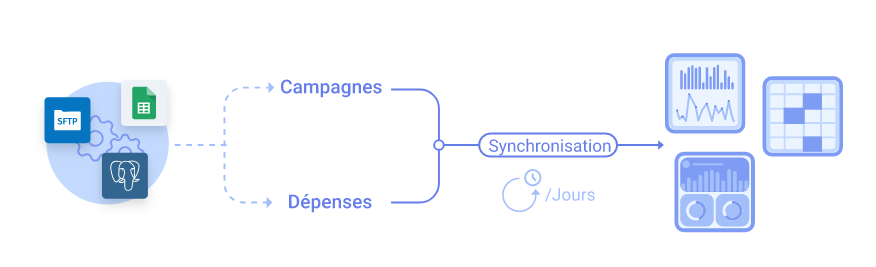
Two custom connectors let you categorize your traffic in an arbitrary way, for cases where your traffic source is unusual and matches none of the standard sources (ad platforms, referring sites, organic or social).
The connectors synchronize the data of your custom source (campaigns / ad spend) from:
- Campaigns declared manually in Webmarketer
- Campaigns declared through the Webmarketer API
- A Google Spreadsheet file
- A database (coming soon)
- A file on an FTP server (coming soon)
- SMS campaign tracking
- Email campaign tracking
- Affiliate traffic tracking
To learn more, see our guide: Configuring custom connectors