Interactions
Introduction
An interaction is the journey a user takes on your website — also called a "session" — and is a set of page views. An interaction can be linked to a traffic source through the wmktId and the ad identifiers.
To collect the interactions happening on your website, you have to configure tracking on your project.
Sessions and page views
The tracking script sends page views to Webmarketer, which makes it possible to build the user's sessions, and therefore the user's interactions on your website.
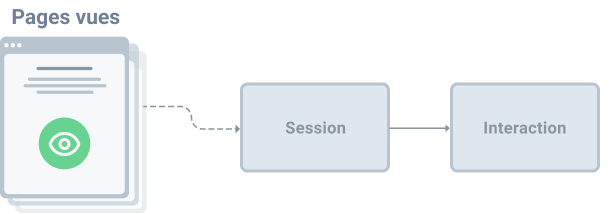
Every workspace has a monthly cap on the number of interactions, set by its billing plan and, where applicable, by the overage allowance configured. Learn more
When an interaction is created, it is tagged based on the URL of the session's first page view. Tagging follows a set of rules and makes it possible to attach an interaction to a source.
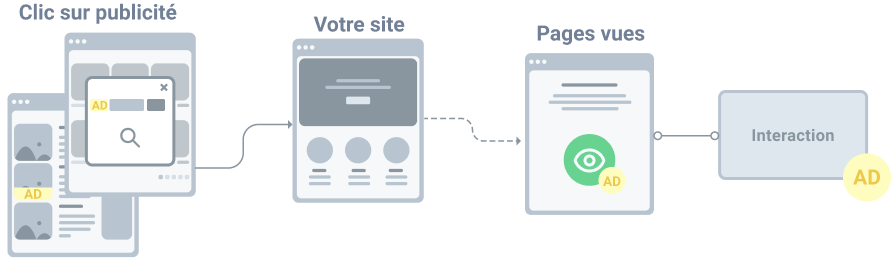
Interactions are used during attribution, which makes it possible to analyze how traffic sources contribute to an event, a state or a statistic.
The interaction explorer
The interaction explorer lets you browse all the interactions belonging to your project over a given date range.
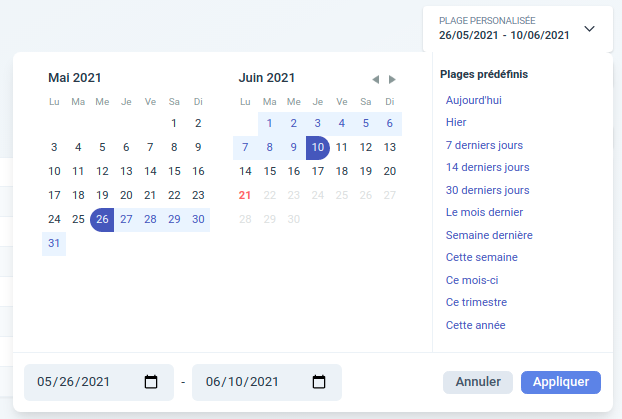
Filtering
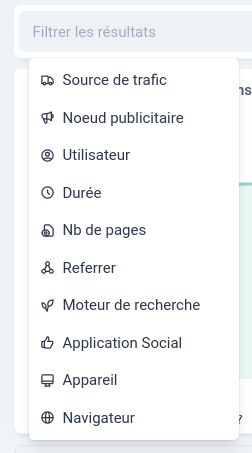
To make browsing easier, interactions can be filtered on the following data:
Interaction list
The "interactions" view presents, as a table, the general information about each interaction that happened on your website, in particular the source URL, the referrer and the source. You can see everything attached to an interaction by clicking directly on its row. From the interaction details, you can also reach the Webmarketer user record.

Interaction list
Evolution chart
Alongside the interaction list, Webmarketer gives you access to a chart showing the number of interactions over time.

Number of interactions per day
You can change the date range as well as the granularity (day, week, month, and so on).
By default, the chart shows how the number of interactions evolves over time, but interactions can also be grouped by source type (organic, social, ad platform, and so on) or by device type (mobile, desktop, and so on).
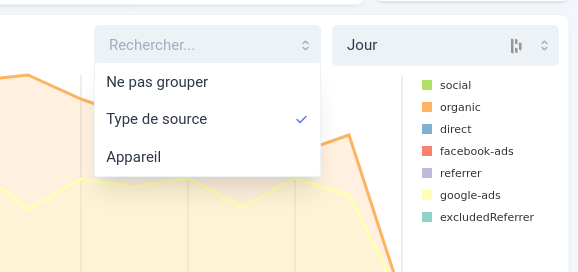
Breakdown by source type, per day