Tracking configuration
To be able to attribute an event to the marketing actions that led to it, Webmarketer needs to know how your visitors browse.
To that end, a tracking script has to be added to your website, either:
- directly in your website's source code,
- or in your favorite tag manager.
We strongly recommend configuring a tracking subdomain to guarantee the quality of the collected data and avoid third-party cookie restrictions. Without it, the collected data is likely to be incomplete and/or inconsistent.
show more
Cookies can be treated as third-party cookies by browsers when a site A loads a resource (a script or a pixel, say) from a site B and the visitor already had a cookie on site B. Sending that third-party cookie to site B is what lets vendors such as Google, Microsoft, Facebook and others track your browsing across the various websites you visit.
That practice quite legitimately raises privacy concerns, which is why browser vendors increasingly prevent third-party cookies from being sent, thereby stopping those advertising giants from tracking your browsing across different websites.
As of writing this page, Firefox and Safari have already chosen to stop sending third-party cookies.
By preventing third-party cookies from being sent, browsers also catch in their net the "first-party" analytics solutions that collect your data without pooling it with that of other websites — data you should legitimately be able to analyze.
If you install Webmarketer on your website without configuring a tracking subdomain, browsing information is sent, by default,
to the ndrstnd.io domain.
Since ndrstnd.io is a different root domain from your website's, the cookie is treated as third-party and may well not be
sent.
Webmarketer is built around first-party data collection, meaning all the collected data is scoped to your project and is neither pooled nor combined with the browsing data of other websites.
Adding the tracking script
DNS configuration
Configuring a tracking subdomain lets the tracking cookie be set in first-party mode. That confines it to your root domain and your subdomains, and therefore stops browsers from treating that cookie as a third-party cookie, allowing tracking that is both optimal and respectful of your users' privacy.
Setting up that tracking subdomain requires creating a subdomain on the root domain of your website(s).
- Go to your domain name management interface (OVH, Gandi, Cloudflare, and so on)
- Go to the DNS record management section of your domain name
- Add a
CNAMErecord- Choose the subdomain you want to use *
- Set
ndrstnd.ioas the target domain name
It is best to avoid keywords that some browser extensions may block, such as tracking, ads, webmarketing, and so on.
Once the DNS record is created, you can add your subdomain to your project configuration through the User tracking submenu.
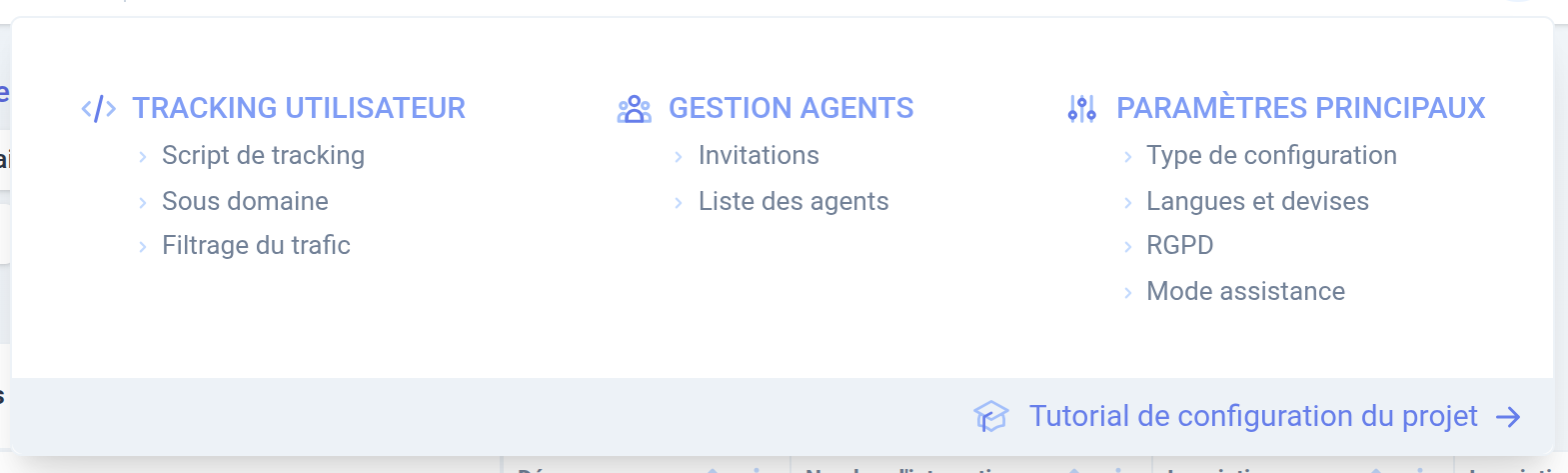
Once your subdomain is added, Webmarketer:
- checks that the subdomain configuration is correct and properly propagated
- generates an SSL certificate to secure the exchanges between visitors and Webmarketer
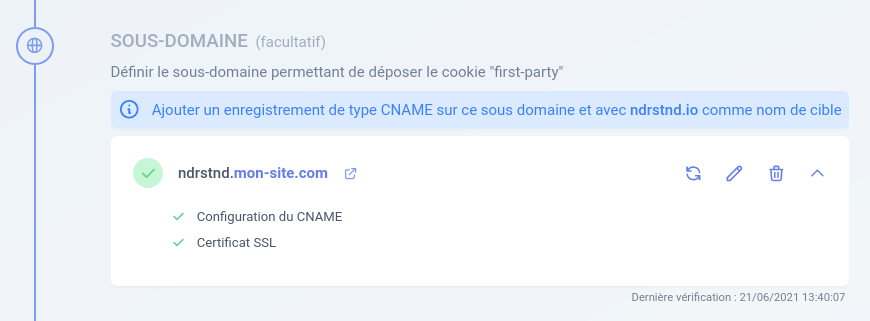
If you use Cloudflare, you have to disable the Cloudflare proxy on the tracking subdomain.
Adding and configuring the script
If you use the Webmarketer WordPress or PrestaShop plugins, this configuration is not needed.
Note that the tracking script below may differ once a tracking subdomain is configured. It is best to grab the tracking script from the User tracking section of your project.
Once the subdomain configuration is validated, the tracking script becomes available to add to your website.
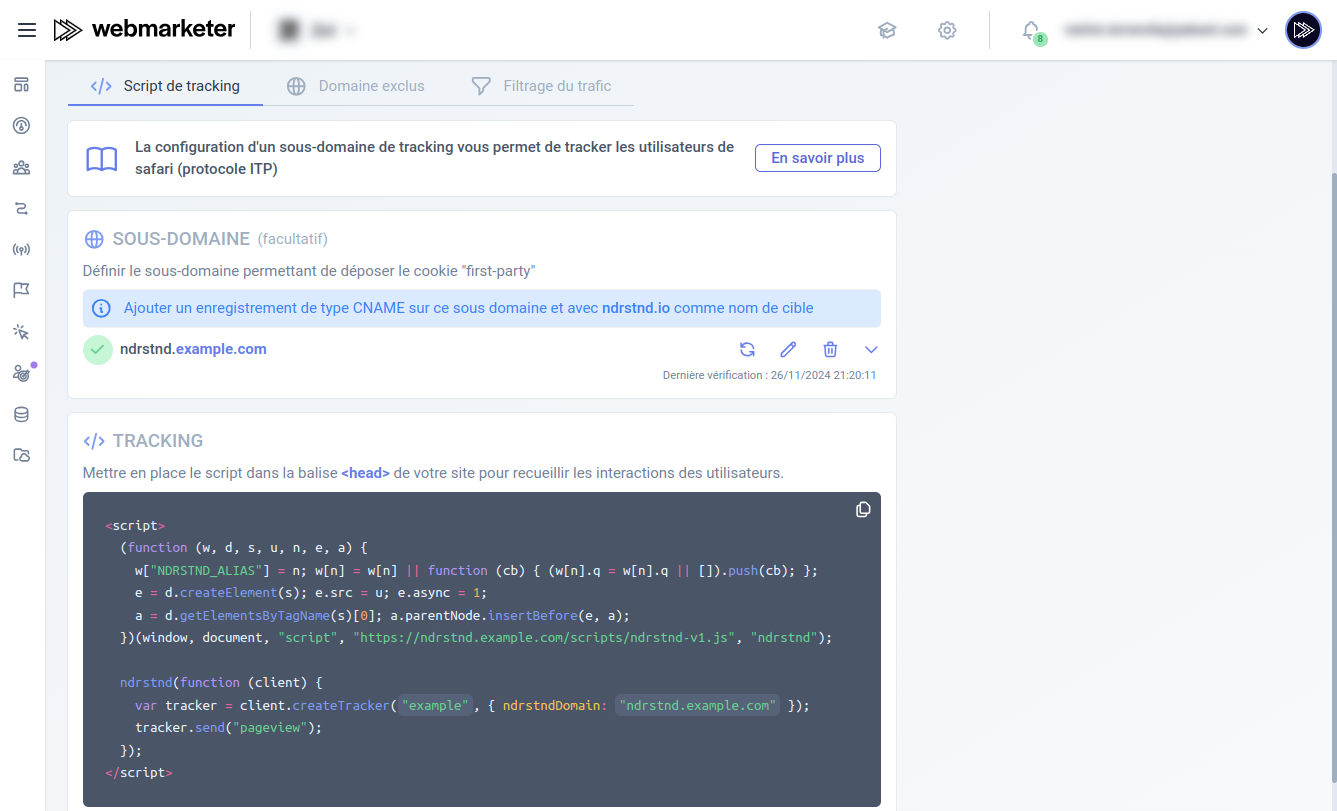
That tracking script has to be added to every page of a website in order to send browsing data to Webmarketer.
Note: you can configure the tracking script more precisely to suit your needs; for more information, see the technical documentation of the script.
Installing through a TMS
Installing the tracking script through a TMS is not recommended, as a fair number of browser extensions block them from loading.
If you still want to install the tracking script through a TMS, reach out to our support team for help, or see the technical documentation of the script.
Once the script is in place, the first sessions show up in Webmarketer within an hour at most.
The tracking script collects page views, which Webmarketer turns into interactions. It sends no event: your conversions (purchase, form submission, sign-up, and so on) have to be reported through the Webmarketer API. See Sending events.
Protected parameters
The script collecting visitors' browsing data may lead Webmarketer to collect sensitive data. While it is generally best to avoid passing any sensitive information in URL parameters, we know it is sometimes unavoidable for technical or business reasons.
To avoid disclosing that sensitive information, Webmarketer lets you configure a list of URL parameters to be treated as "protected".

Configuring protected parameters
You can define which parameters must be treated as "protected" in your project settings, User tracking section, Protected parameters tab.
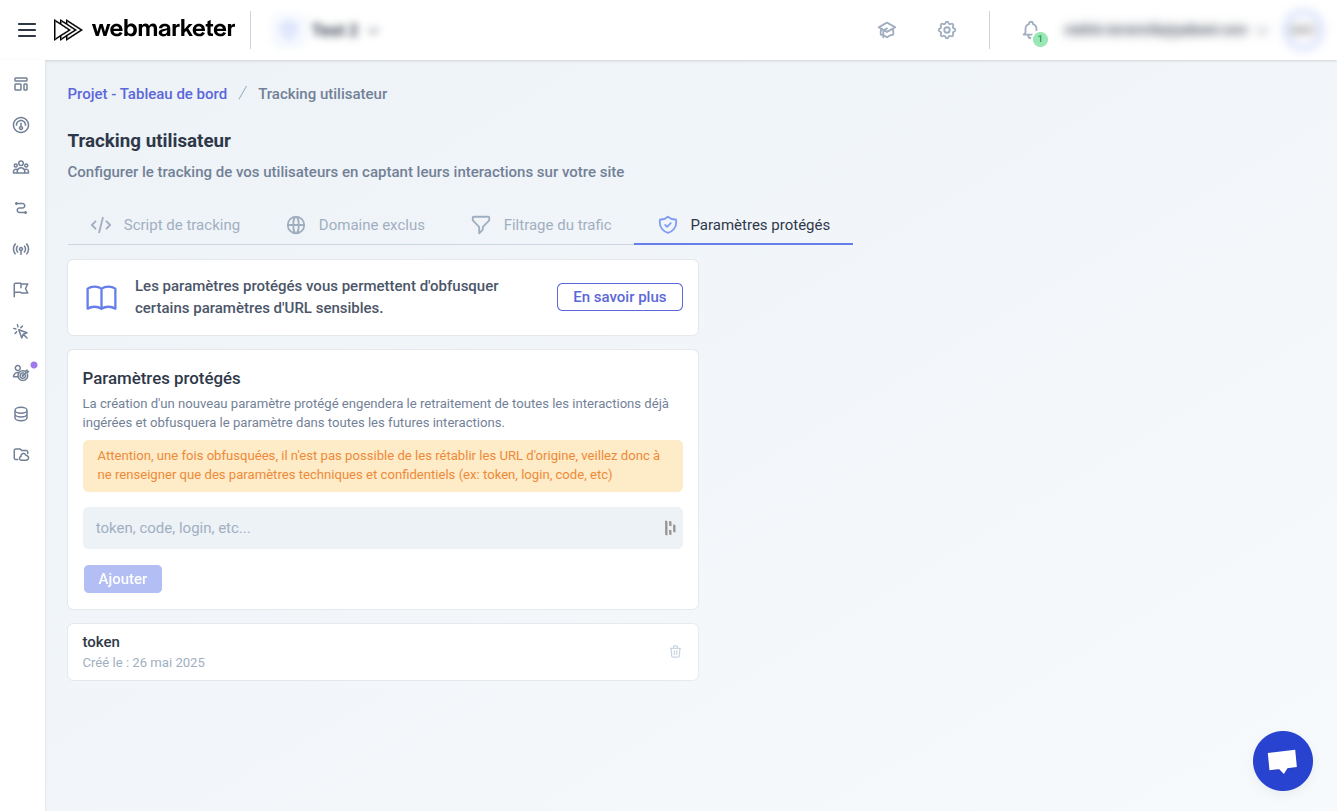
Creating a new protected parameter triggers the reprocessing of every interaction already ingested by Webmarketer* and obfuscates the parameter in all future interactions.
* this may take several minutes, depending on the volume of collected data and the load on the system.
Beware: removed parameters cannot be restored. So only enter keys whose removal you are certain about (token, login, code, and so on).