Configuring Google Ads URL parameters
To work at its full potential, Webmarketer needs to identify which ad platform, campaign or ad group your visitors come from.
To make that possible, you have to tag the landing page URLs of your campaigns with parameters that identify the ad nodes the session originated from.
In Google Ads, the URLs redirecting to your website can be configured at every node level (account, campaign or ad group). That kind of configuration is not recommended though, since it remains possible to miss some campaigns, which then prevents Webmarketer from matching your Google Ads sessions with the corresponding ad spend.
So that the URL parameters apply to all of your ads, current and future ones alike, we recommend configuring this at the account settings level.
Expected parameters
wmktid: tells Webmarketer which integration the session originated fromcaid: tells Webmarketer which campaign the session originated fromagid: tells Webmarketer which ad group the session originated from
The placeholders provided by Google — {campaignid}, {adgroupid} — let you configure all of your ads generically in a single operation.
Account-level tracking configuration
The URL parameters must be configured through the Final URL suffix option.
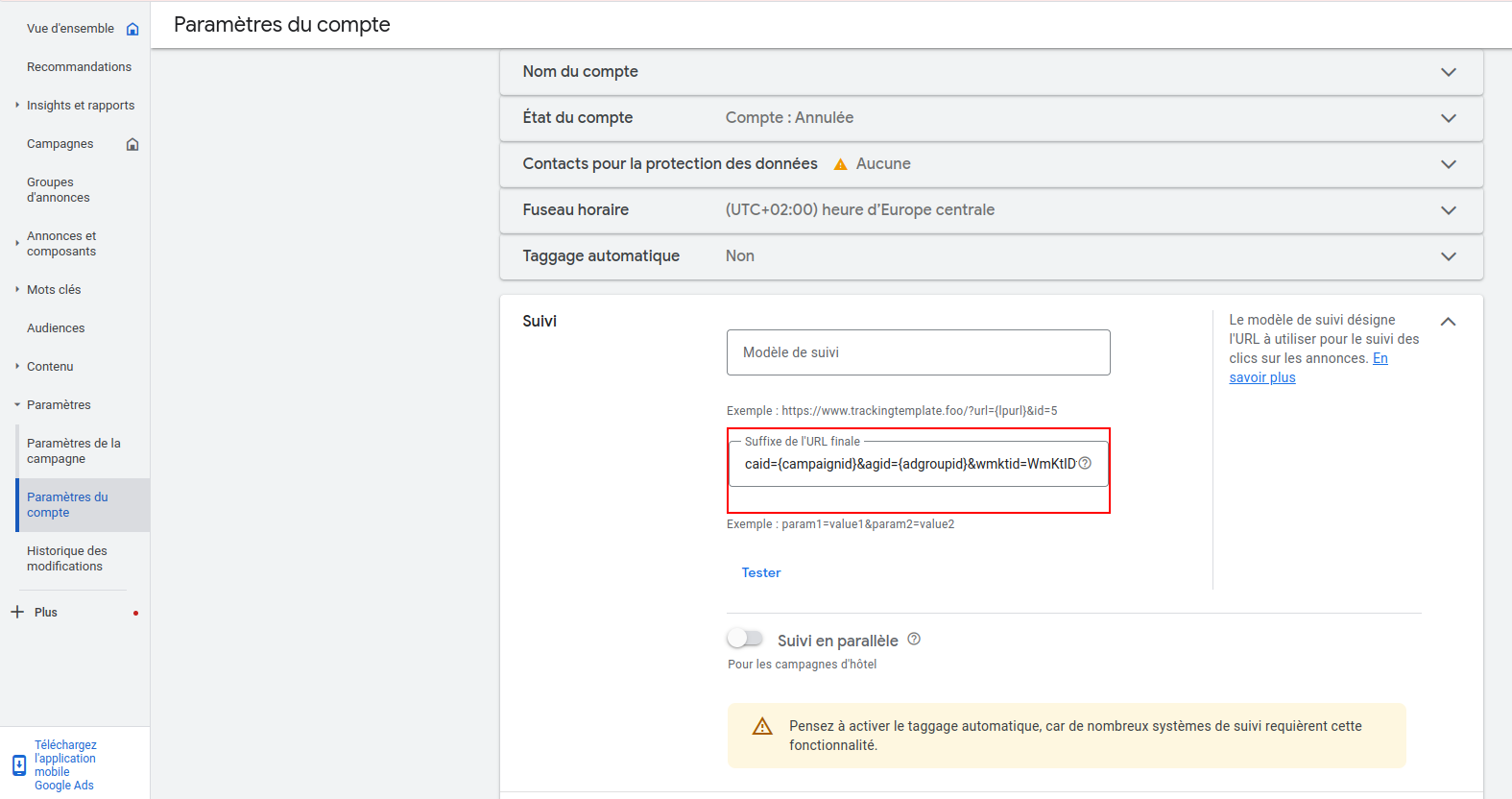
Parallel Tracking, precautions to take
While it is technically possible to add your tracking parameters through the "Tracking template" field, this only works when the field starts with {lpurl}, and it amounts to misusing that field.
The "Tracking template" field is meant to hold values such as: https://trackingtemplate.foo/?url={lpurl}&caid={campaignid}
And when that field is properly configured, the parameters it contains:
- will not appear in the visitor's URL
- will be sent in the background request (Parallel Tracking)
This is why Webmarketer flags URL tagging as in error when the parameters are set in the "Tracking template" field instead of the "Final URL suffix".