Configuring user fields
Every time Webmarketer receives a high-value event, it tries to work out whether an already known user produced it.
To do so, it looks for:
- Existing users with the same browsing identifier (cookie)
- Users with identical
identifiervalues (for example: the ID of the account the visitor is logged into, sent by the tracking script) - Users with an identical identification field (for example: email address, phone number, customer number, and so on)
If a user is found, the event is then attached to that user. Otherwise, a new user is created and the user data sent within the event is attached to that new user.
Learn more about user reconciliation.
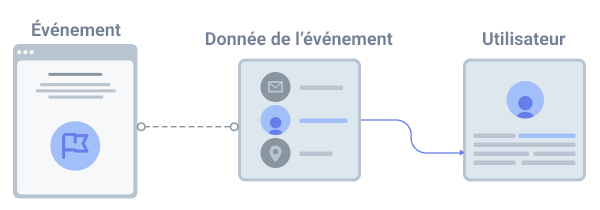
Declaring user fields
User fields have to be created from Webmarketer. In the Webmarketer interface, go to the "Events" page and click the User data tab.
For each user field, you can then provide:
- a technical key, used when sending the event to Webmarketer,
- a label, for display purposes,
- its field type (text, number, email, location, and so on)
Identification fields
As you declare the various pieces of data your organization collects, you can also decide which of them you use as identification fields.
As a reminder, identification fields are what allow Webmarketer to recognize that two events were produced by the same person. Email and phone number are usually the right choice.
Learn more about user reconciliation.
Personal data fields
This is also where you can indicate which fields hold "personally identifiable information".
To learn more about how Webmarketer anonymizes data, see the Data anonymization page.
Once your fields are configured
Once all user fields are filled in, you are ready to configure your event types 🎉
Should you create new user fields later on, you can always add them afterwards.
