Configuring an attribution model
In Webmarketer you can create several attribution models and compare their performance — because how much a traffic source contributes to an event is subjective.
You can configure a new attribution model from the attribution model list, reachable from the side menu.

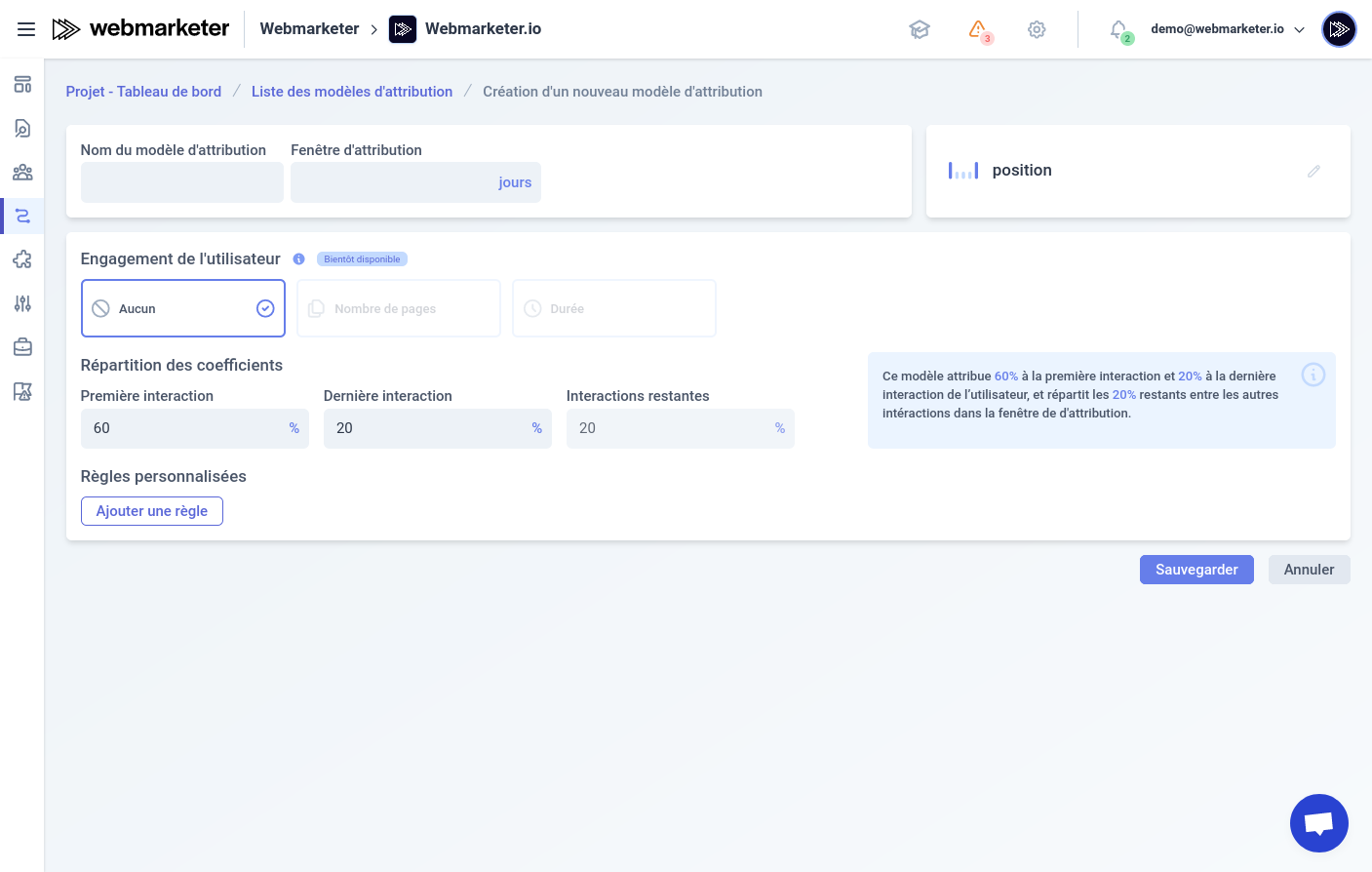
You can set a name to identify it more easily throughout the application, as well as the attribution window.

Choosing the model type
There are several model types: Linear, Position, Time decay, First interaction and Last interaction.

Depending on the type you select, some options become configurable. Below, for the position type, you have to configure how the coefficients are distributed.
Defining custom rules
When attributing an event, a rule's coefficient is applied to every interaction of the attribution window that satisfies that rule.
Rules can evaluate the data carried by the interaction — for example: session duration depending on the ad, and so on.

Defining the target of the rules
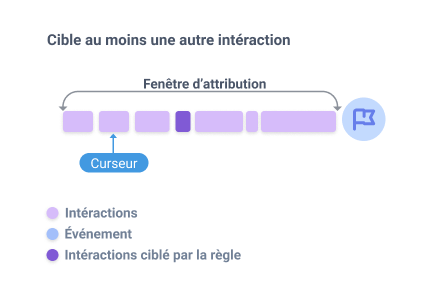
By default, rules are evaluated against the interaction currently being evaluated. In the Advanced mode of the custom rule engine, you can target another interaction, or all the other interactions of the attribution window.
Rules can target the interaction currently being evaluated.

A rule's coefficient is applied to the interaction currently being evaluated if at least one other interaction satisfies the rule.
A rule's coefficient is applied to the interaction currently being evaluated if all the other interactions satisfy the rule.
