Ad spend timezones
Some Webmarketer reports combine data coming from different sources.
That is the case, for instance, of the performance explorer, which displays:
- ad spend, imported from your ad platforms,
- the interactions observed on your website, measured directly by Webmarketer.
The problem
To display consistent data, Webmarketer needs to know precisely the time range over which the ad spend was incurred, so it can align that range with the one over which the interactions are counted.
Without that information, computed data can be skewed and analyses wrong.
An example of data being misinterpreted:
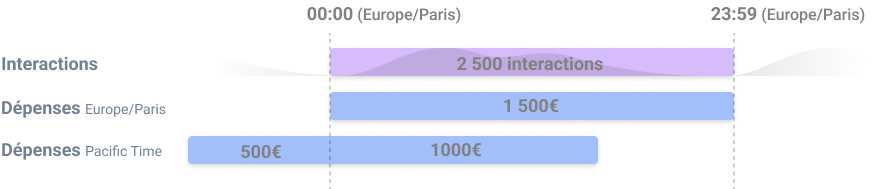
The example above illustrates the misalignment between ad spend and interaction data.
If the ad spend is expressed in Europe/Paris, it means €1,500 were spent to generate 2,500 interactions. If the ad spend is expressed in Pacific Time (UTC -8), it means €1,000 were spent to generate 2,500 interactions.
This example shows how important timezone alignment is to analyze performance accurately. Here, the cost per session ends up 33% off because of that timezone mistake:
- Europe/Paris = €0.60/session
- Pacific Time = €0.40/session
The solution
Webmarketer sets the timezone of your ad spend automatically whenever possible, for the following ad platforms:
- Google Ads
- Meta Ads
- Microsoft Ads
- LinkedIn Ads
- Snapchat Ads
- TikTok For Business
- Pinterest Ads
You will however have to configure a timezone for "manual ad platforms":
- Custom ads
- Google Spreadsheet