Data anonymization
To comply with the rules laid out by the General Data Protection Regulation (GDPR), Webmarketer lets you configure your anonymization policy.
As a reminder, the regulation applies without exception to all European Union citizens. Failing to comply with those directives can lead to sanctions from regulatory authorities.
See the French CNIL website for the detailed regulation (in French).
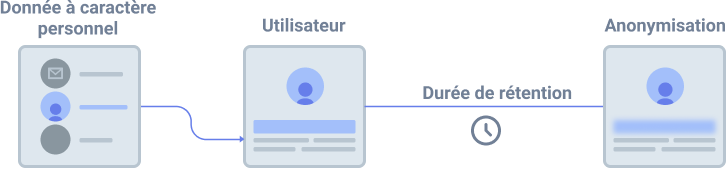
Webmarketer relies on the configuration of your project, your fields and your event types to anonymize personally identifiable information (PII) automatically.
Webmarketer also anonymizes incrementally, at each expiry, keeping accessible the data whose period has not expired yet.
PII fields
Some event or user fields are not meant to collect personally identifiable information, and anonymizing such fields would cause the loss of valuable statistical data about your history.
Webmarketer lets you configure precisely which fields must be anonymized once the retention period is reached, by
declaring your fields as PII.
Every user field and every event field can therefore be marked as PII.
Once marked, it is anonymized as soon as the retention period is reached.
To learn more about configuring PII fields, see the getting started guides Configuring user fields and Event configuration.
Retention period
The retention period defines how long after collection the data must be anonymized.
By default, Webmarketer uses the period defined globally at the project level; the period defined at the event type level takes over as soon as you set a value different from Use project configuration.
Changing the retention period is not retroactive!
Retention periods are handled individually for each piece of collected data, and a data point's expiry date is set when it is ingested, based on the configuration as of that date.
To learn more about configuring retention data, see the getting started guide Configuring your project for GDPR.
Partial anonymization
As you can read on the users concept page, users can hold several values for the same user field.
Since those values were ingested at different dates, their expiry dates differ. Each value is therefore anonymized individually on its own expiry date, until the user is fully anonymized.
A special case: the "location" field
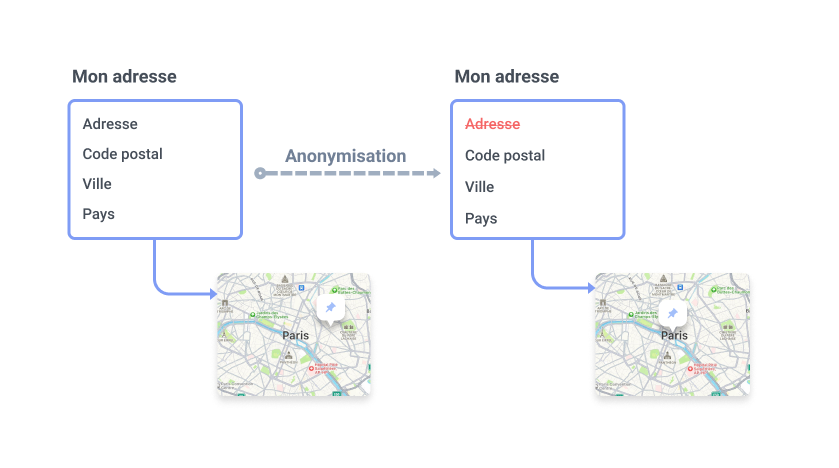
The GDPR considers that a location more precise than the city constitutes personal data, which leaves room to collect the city without triggering any anonymization requirement. So when Webmarketer anonymizes location-type data, only the street address component is anonymized, keeping the postal code, the city and the country.
You can therefore keep using geographic data at city level in your analyses.